


I have had some version of the same conversation about 1,500 times.
Someone calls me thinking they need a specific house. A certain zip code, a certain school district, a certain commute time. After we really talk, it turns out they are not looking for a zip code at all. They are trying to solve something. Less space than they need. Too much lawn for where they are in life. Too far from family.
The house is almost never the real story.
But the county? The county matters more than most people think. In a metro the size of DFW, the eight counties that make up this market are not interchangeable. They offer different trade-offs and are moving at different paces right now. After fourteen years in Texas real estate and nearly 30 years combined in banking and real estate, here is what I am actually seeing on the ground in mid-2026.
What Does It Mean to "Buy in DFW" in 2026?
"DFW" is shorthand for a market that spans eight counties, hundreds of cities, and price points that range from the low $200,000s to well north of $1 million. When someone says "I am thinking about buying in DFW," they have not said much yet.
The eight counties Momentus covers are Collin, Denton, Tarrant, Dallas, Ellis, Kaufman, Rockwall, and Grayson. Each one plays a distinct role in this market, and each is moving at its own pace. Here is the honest read.
Collin County: What Should Buyers Expect in the Northern Corridor?
Collin County is one of the most active new construction corridors in North Texas. Cities like Frisco, McKinney, Plano, Allen, Prosper, and Celina carry a large share of master-planned development in the metro.
What buyers find here: newer homes, larger lots in the outer cities (Prosper, Celina, Anna), and a range of price points depending on how far north you go. The trade-off is distance from the Dallas urban core.
Collin sits at the high end of DFW median prices in the suburbs. Buyers coming from out of state who expect to get more house for significantly less money sometimes need a recalibration once they see the numbers. It is still favorable compared to what they left, but it is not the bargain it was four or five years ago.
Denton County: Why Does the Western Side of DFW Draw So Much Attention?
Denton County spans a lot of ground. It includes Flower Mound and Lewisville in the southeast (more established, easy airport access), Argyle and Bartonville in the central stretch (more land, quieter pace), and communities like Little Elm and Pilot Point farther north.
Denton itself, home to the University of North Texas and Texas Woman's University, has a distinct character compared to the rest of the county. The university footprint brings arts and music venues and a downtown with real energy, alongside a higher renter-to-owner ratio in parts of the city.
Lake Lewisville and Grapevine Lake are on the Denton County side. Buyers who want water access without driving hours for it often land here. Trade-off: heavier traffic on the I-35W and 2499 corridors.
Tarrant County: What Makes Fort Worth and Its Surrounding Cities Different?
Tarrant County is often where I send buyers who want the character of a real city without paying Dallas prices for it.
Fort Worth has genuine cultural anchors: the Stockyards National Historic District, the Cultural District (the Kimbell, the Amon Carter, the Modern), Sundance Square, and the TCU area. These took decades to build and they show.
The county also includes Keller, Southlake, and Colleyville (some of the highest residential price points in the metro), Grapevine with its walkable historic downtown, and Arlington with Globe Life Field and AT&T Stadium.
Of the 600+ veteran families I have worked with across DFW, a significant share have landed in Tarrant County. The VA loan market is active here.
Dallas County: Who Is the Dallas County Buyer Right Now?
Dallas County includes the urban core (Uptown, Oak Lawn, Lake Highlands, Preston Hollow, East Dallas, Oak Cliff) alongside inner-ring cities like Irving, Garland, Mesquite, and Desoto.
The inner-ring neighborhoods have some of the tightest inventory in the metro and the highest per-square-foot prices. The trade-off: walkability, shorter commutes, genuine neighborhood character. Garland and Mesquite offer older housing stock at more accessible prices for buyers who want to stay closer to the core.
Ellis County: What Is the Southern Corridor Trade-Off?
Ellis County sits south of Dallas, anchored by Waxahachie and Midlothian, with Ennis in the eastern stretch.
The appeal is straightforward: more land, more house, and more breathing room per dollar than most counties north and east of Dallas. Waxahachie has a genuinely charming historic square and some of the most striking Victorian architecture in North Texas. Midlothian has seen significant industrial growth alongside residential development.
The trade-off is commute. Buyers who land in Ellis County are making a deliberate choice to trade proximity for space and price. For many, that is exactly the right call. It depends on the rest of the picture.
Kaufman County: Why Are Buyers Looking East of Dallas?
Kaufman County, primarily Forney and Terrell, has emerged as one of the more active areas in the eastern DFW expansion. Forney in particular has drawn consistent residential development.
The story here mirrors the southern corridor: land is less expensive, new construction is more accessible, and the farther from the 635 loop, the more you get per dollar. Forney sits close enough to I-20 to make commuting to southern Dallas County manageable. Terrell carries more of a small-town Texas character and more distance from the core.
Rockwall County: What Makes the Lake Ray Hubbard Side of DFW Distinctive?
Rockwall County is small and distinct. The city of Rockwall sits on the western shore of Lake Ray Hubbard, and that location gives it a character you do not find in many DFW counties. Waterfront access, a tight geographic footprint, and good highway access on I-30.
Royse City, just east of Rockwall, has been one of the faster-growing smaller cities in the county for buyers seeking newer construction at a lower price point than the lake-adjacent properties.
Inventory in Rockwall County runs tighter than in larger counties because there is less buildable land. That constraint tends to support prices, but it also means buyers need to move more decisively when something comes available.
Grayson County: Is the Northern Frontier Worth the Drive?
Grayson County is the one that surprises people most.
Sherman and Denison sit at the northern edge of the DFW metro. For most of the last decade the conversation about this county was purely about value. That has shifted. Technology investment and infrastructure spending have changed what the Sherman-Denison corridor looks like. Denison sits on Lake Texoma, the largest lake on the Texas-Oklahoma border.
Van Alstyne and Anna, which represent the same northward growth story just south of the Grayson County line in Collin County, have seen some of the most active new construction in the entire metro.
If you are buying in Grayson County, you are buying earlier in a growth cycle than the counties to the south. That can work in your favor, but it requires a clear-eyed view of what commute distance means for your daily life.
So Which County Is Right for You?
Honest answer: it depends on what you are actually trying to solve.
That is not a dodge. It is the whole reason I start every conversation by listening before showing houses. A buyer who says "I want Frisco" sometimes ends up in Waxahachie. A buyer who says "I want to be near Fort Worth" sometimes lands in Grapevine because the trade-offs land differently than they expected.
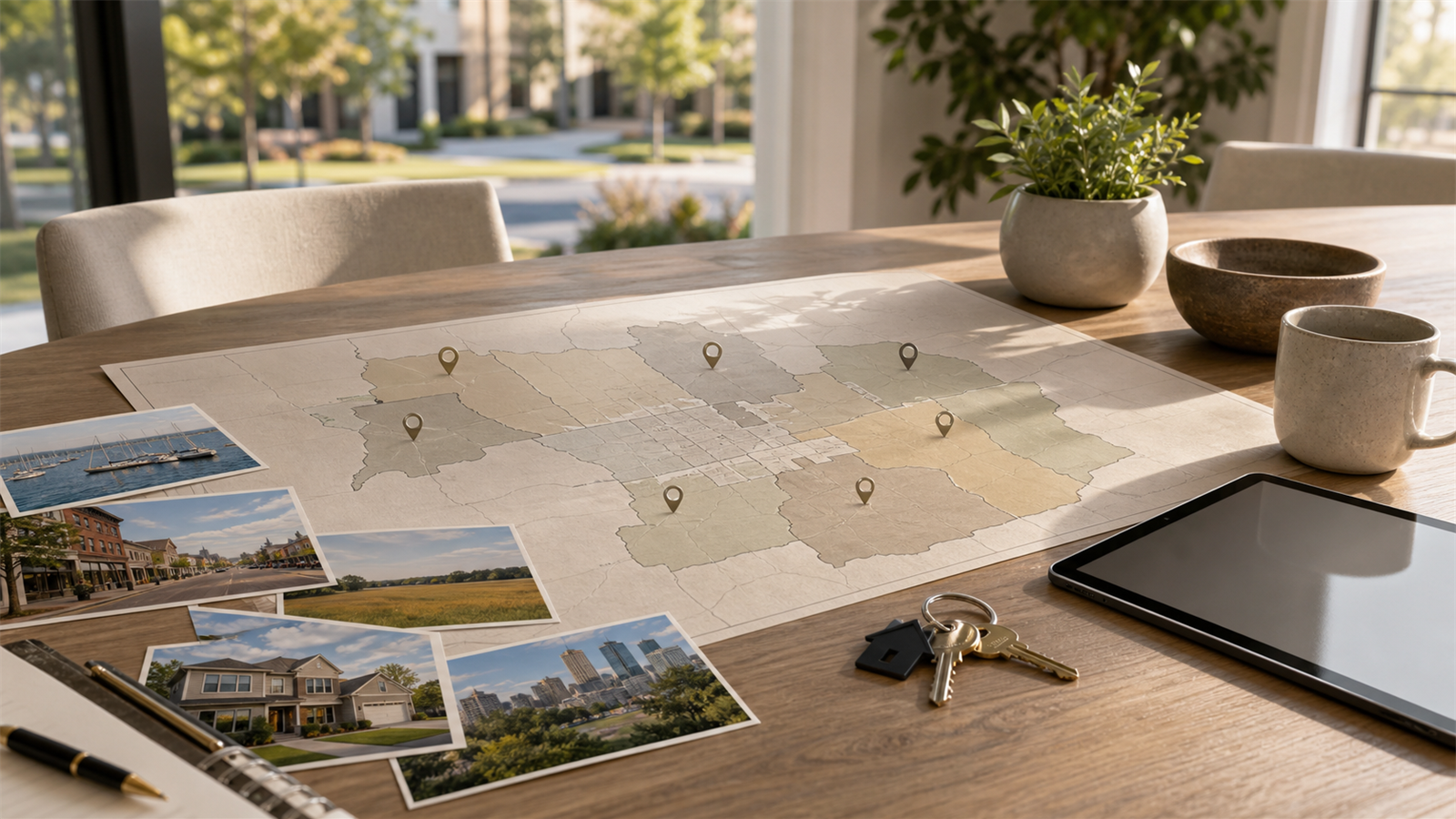
The eight-county map is a starting point, not an answer.
If you are trying to figure out where in DFW you fit, or whether now is the right time to buy or sell, reach out. My team and I will walk you through it. One honest conversation, free, on your schedule, by phone, video, or in person.
Every situation gets three honest answers: yes, you are ready; yes, just not yet, with a plan and a timeline; or not right now, and here is why that is okay. Every lane has a path. And if financing is part of the picture, you will hear directly from the right lender for your situation, someone who tells you exactly where you stand and puts it in writing.
The full guide to each Momentus path is at momentusdfw.com. Start there, or reach out directly.
People first. Houses second.
Maureen Cappallo
Founder and Broker, Momentus Real Estate Group
TREC #9014872
Maureen Cappallo is a Texas real estate broker, not a mortgage lender or loan officer. County market observations are general and educational. A licensed lender confirms your specific financing timeline and numbers.
Check out this article next